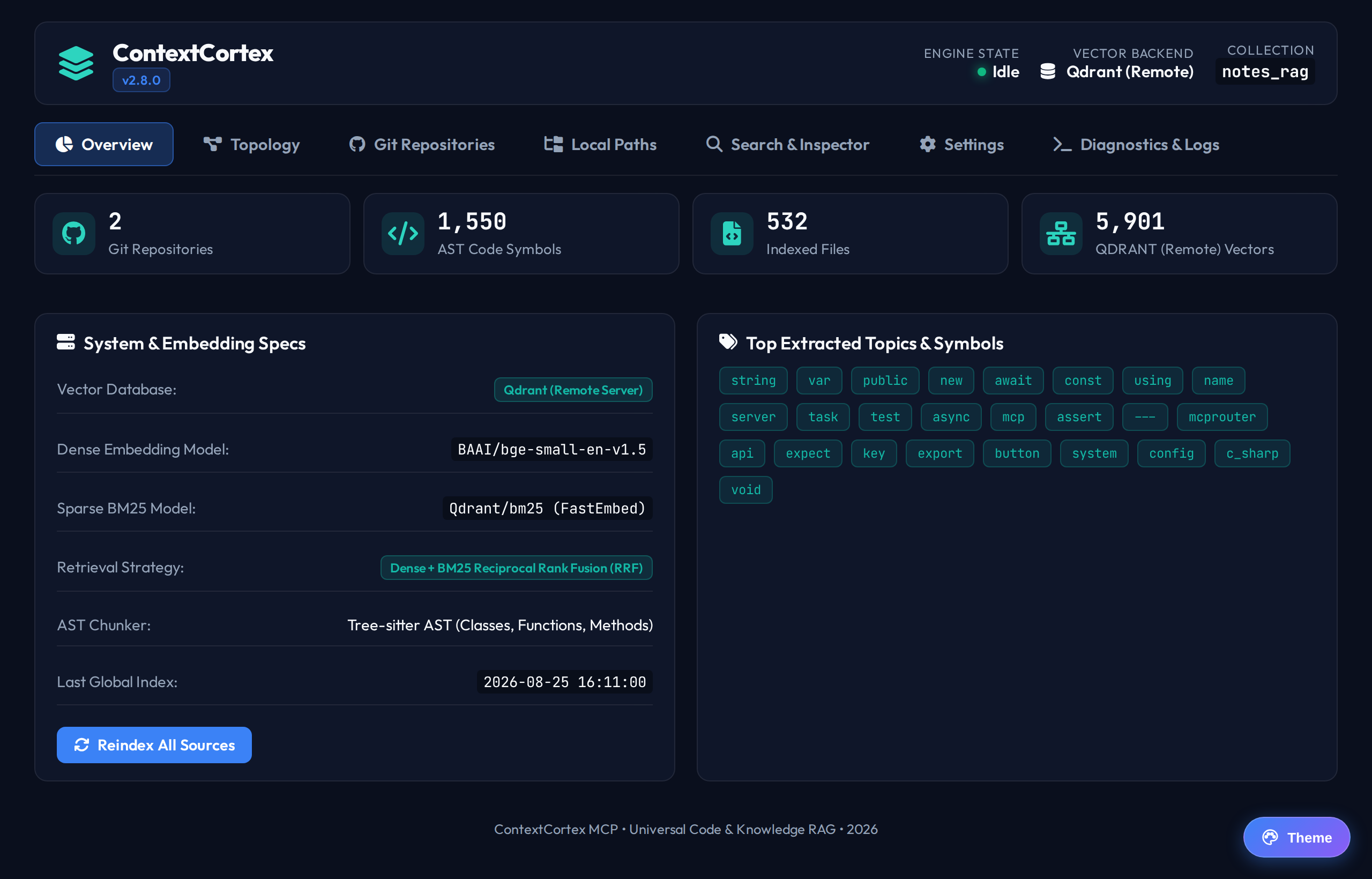
System Architecture: ContextCortex
ContextCortex provides fast, local, syntax-aware semantic and hybrid search over source code repositories, architecture documents, and notes. The system operates natively on the Model Context Protocol (MCP) SDK 2.0.0+ using FastMCP.
All backend services and frontend components follow a modular architecture. Source code files maintain a strict sub-500 LOC per file maintainability limit.
Architecture Principles
ContextCortex adheres to these core design principles:
Syntax-Aware Parsing: The system parses source code into Abstract Syntax Trees (AST) using Tree-sitter. It preserves semantic boundaries for functions, classes, and methods.
Dual-Engine Relational Storage: The relational layer supports both SQLite in Write-Ahead Logging (WAL) mode and PostgreSQL 16 with native pgvector indexing.
Pluggable Vector Store Backends: Vector storage adapters isolate search engines from application logic. Administrators can switch between Qdrant, pgvector, and ChromaDB without application restarts.
Ephemeral Repository Ingestion: To conserve disk storage, the system clones remote repositories using shallow clones (
--depth 1). It extracts AST symbols and vector embeddings, then purges the cloned directory immediately.Security and Role-Based Access Control: The server enforces RFC 9728 OAuth 2.1 authentication and cryptographically validated API keys across three permission levels (Viewer, Editor, and Admin).
Architectural Documentation Map
- System Design and Components: Complete component diagram and runtime interaction flows.
- Data Pipeline and Ingestion: AST chunking pipeline, vector embedding generation, and PDF processing.
- MCP Protocol and Security: Transports (SSE and Streamable HTTP), RFC 9728 discovery, and RBAC hierarchy.
- Database and Storage Schema: Unified relational schema, entity relationships (ERD), and vector payload structures.