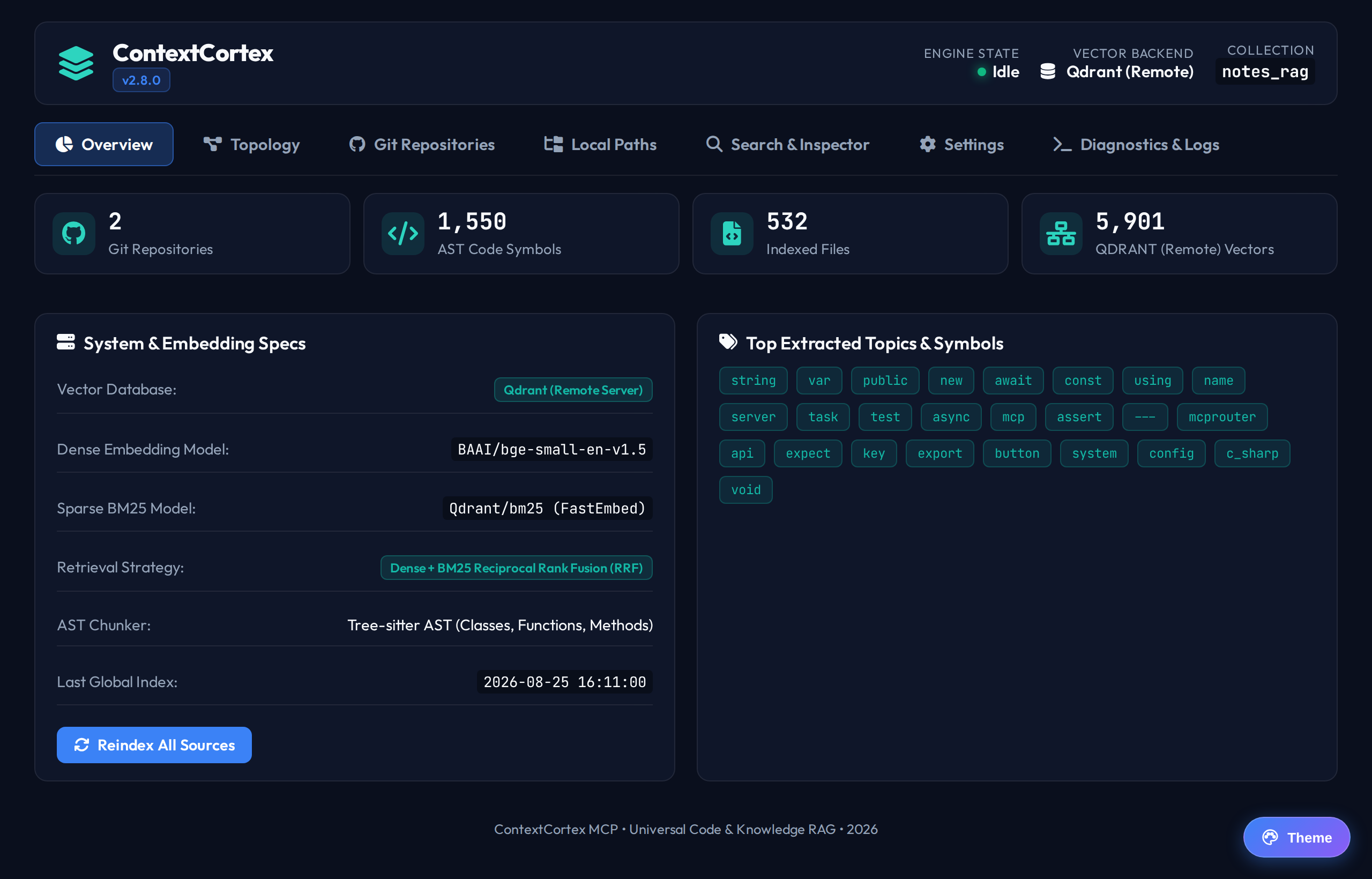
Data Pipeline and Ingestion
This document details the data ingestion, parsing, chunking, and embedding pipelines.
Ingestion and Chunking Sequence
The following sequence diagram illustrates the lifecycle of a repository synchronization request:
1. Syntax-Aware AST Chunking
Unlike naive fixed-window chunkers, ContextCortex uses Tree-sitter grammars to parse source code files into concrete syntax trees.
Supported Language Grammars
ContextCortex includes pre-compiled Tree-sitter grammars for:
- Python (
.py) - TypeScript / JavaScript (
.ts,.tsx,.js,.jsx) - Go (
.go) - Rust (
.rs) - C# (
.cs) - C / C++ (
.c,.cpp,.h,.hpp) - Java (
.java) - Ruby (
.rb) - PHP (
.php)
Chunking Logic
- The parser identifies high-level AST nodes (
function_definition,class_definition,method_declaration). - If a node size is within the maximum token threshold (typically 512 tokens), the system preserves the node as an atomic chunk.
- If a class or function exceeds the threshold, the system splits child blocks while maintaining the parent class signature header.
- Each chunk preserves exact source metadata:
filepath,start_line,end_line,symbol_name, andlanguage.
2. Hybrid Embedding Generation and Search
ContextCortex uses hybrid dense and sparse embeddings to achieve high retrieval accuracy.
Reciprocal Rank Fusion (RRF) Formula
The final relevance score for a document $d$ combines rankings from dense and sparse search lists:
$$RRF(d) = \sum_{m \in M} \frac{1}{k + r_m(d)}$$
Where:
- $M$ is the set of retrieval methods (Dense semantic and Sparse BM25).
- $r_m(d)$ is the rank position of document $d$ in retrieval method $m$.
- $k$ is a smoothing constant (default: 60).
3. PDF Document Ingestion and Vision OCR
When administrators upload PDF files to managed local storage:
- Native Text Extraction: The system extracts digital text using
pypdforpymupdf. - Quality Evaluation: If a page contains minimal text or scanned bitmaps, the system flags the page for OCR.
- AI Vision OCR: ContextCortex renders pages to images and queries the configured vision model (for example,
gemini-2.5-flash) to transcribe technical text and diagrams. - Interactive Preview: Users can review extracted chunks and OCR flags in the web dashboard before confirming ingestion.