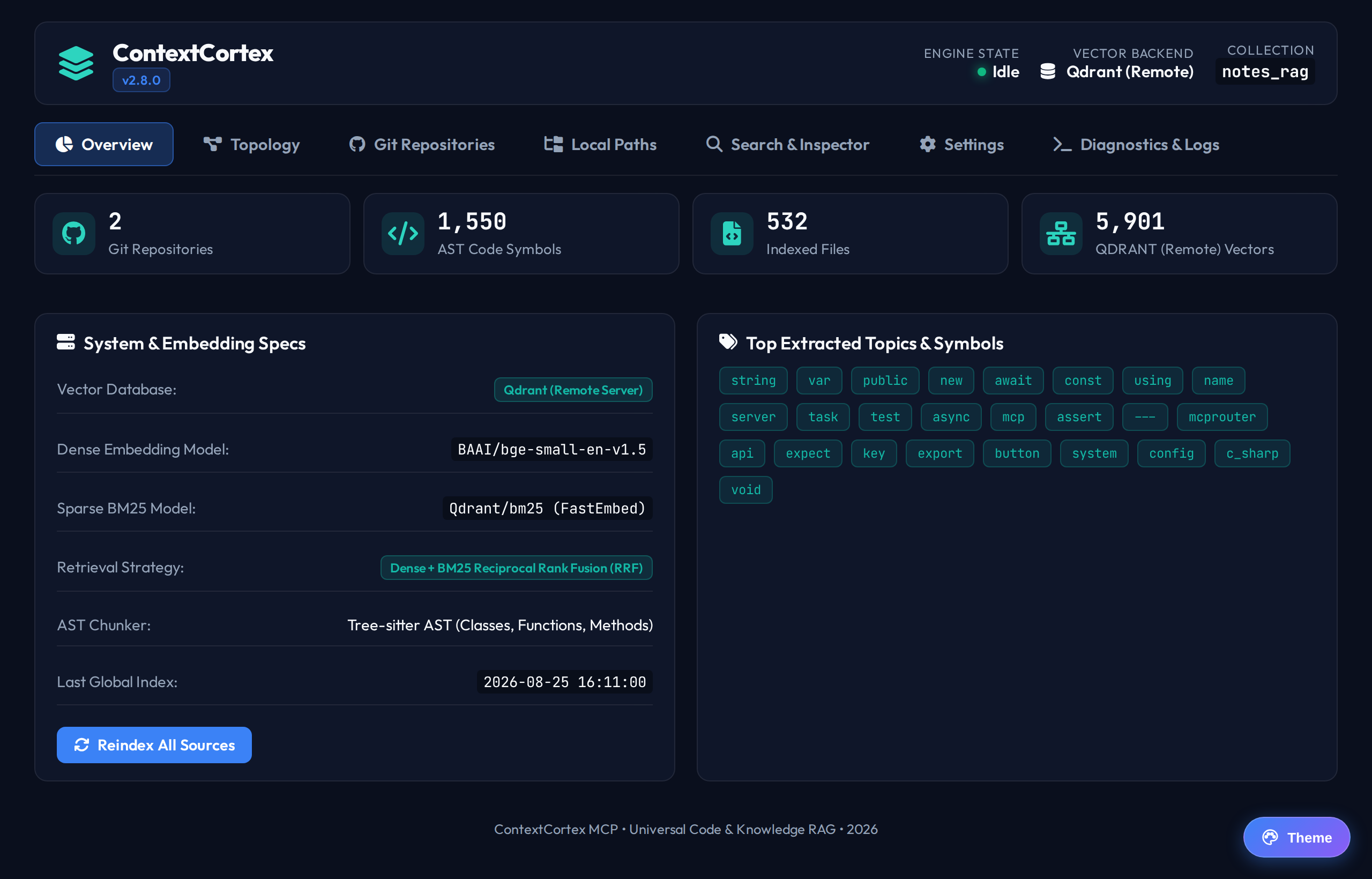
Functional Requirements
This section specifies the functional requirements for ContextCortex.
FR-01: Abstract Syntax Tree (AST) Code Chunking
- Description: The system must parse source code into Abstract Syntax Trees using Tree-sitter.
- Languages Supported: Python, TypeScript, JavaScript, Go, Rust, C#, C++, Java, Ruby, and PHP.
- Behavior: The parser must chunk along function and class boundaries. Chunks must preserve symbol names, parameter signatures, and 1-indexed line numbers.
- Maximum Chunk Size: When a symbol exceeds 512 tokens, child blocks must be segmented while preserving the parent declaration header.
FR-02: Hybrid Dense and Sparse Vector Retrieval
- Description: The system must support hybrid vector search combining semantic similarity and keyword matching.
- Embedding Generation: The system must generate 384-dimensional dense vectors using FastEmbed (
BAAI/bge-small-en-v1.5) and lexical sparse vectors using BM25. - Ranking Algorithm: The system must combine dense cosine similarity scores and sparse BM25 scores using Reciprocal Rank Fusion (RRF with $k=60$).
FR-03: Dual Relational Storage Engines
- Description: The system must maintain relational metadata using SQLAlchemy 2.0 Core unified schemas.
- PostgreSQL 16 Engine: Production containerized mode with pooled connections (
psycopg3) and nativevector(384)HNSW indexing. - SQLite WAL Engine: Zero-configuration embedded disk mode with automatic Write-Ahead Logging and a 5000ms busy timeout.
FR-04: Pluggable Vector Store Backends
- Description: The system must support dynamic vector database adapters without server restarts.
- Engines Supported: Qdrant (remote server and embedded disk), PostgreSQL pgvector, and ChromaDB.
- Runtime Switching: Administrators must be able to test connection health and switch active vector backends via the Settings interface or REST API.
FR-05: Universal Git Provider Synchronization
- Description: The system must ingest remote Git repositories from GitHub, GitLab, Gitea, Forgejo, Bitbucket, and generic Git hosts.
- Ephemeral Clones: The system must perform authenticated shallow clones (
--depth 1), extract symbols and vectors, and immediately remove repository files from host storage. - Custom Credential Vault: The system must store domain-level Git host tokens for internal and self-hosted instances.
FR-06: Managed Local Storage and Real-Time Indexing
- Description: The system must provide a managed local storage directory (
/app/data/storage) for uploaded files. - Security: The system must sanitize all file paths to prevent directory traversal attacks (rejection of
.., leading slashes, and null bytes). - Immediate Indexing: Uploaded and modified files must be indexed into the vector store immediately. Deleted files must have their relational records and vector points purged without delay.
FR-07: PDF Document Ingestion with Vision OCR Fallback
- Description: The system must process PDF documents up to 50 megabytes in size.
- Text Extraction: The system must extract digital text layers using
pypdf. - Vision OCR Fallback: When pages contain minimal digital text or complex technical diagrams, the system must trigger optical character recognition using the configured LiteLLM vision model.
- Preview Modal: The system must present an interactive preview showing extracted text, sample chunks, and OCR flags before committing to vector storage.
FR-08: Model Context Protocol (MCP) 2.0 Compliance
- Description: The system must implement the official Model Context Protocol (2026-07-28) using
FastMCP. - Transports: The system must provide Server-Sent Events (SSE) at
/sse(with/messages/) and Streamable HTTP at/mcp. - Tools: The system must expose 14 dedicated agent tools (
search_code,search_docs,find_symbol,get_file_outline,list_repositories,sync_repository,index_status,get_architecture,manage_adr,get_code_routes,trace_call_path,manage_local_file,what_is_ingested).
FR-09: RFC 9728 OAuth 2.1 and 3-Tier RBAC
- Description: When
AUTH_ENABLED=true, the server must act as an RFC 9728 OAuth 2.1 Protected Resource Server. - Metadata Endpoint: The server must expose authorization metadata at
GET /.well-known/oauth-protected-resource. - Roles: The system must enforce three permission tiers: Viewer (Level 10), Editor (Level 20), and Admin (Level 30).
- API Keys: The system must authenticate requests bearing
cc_API keys verified against SHA-256 database hashes.
FR-10: 3-Pane Codebase Navigator
- Description: The web dashboard must provide an interactive 3-pane architectural navigator.
- Pane 1 (Files & Modules): Virtualized tree hierarchy with search filter and symbol badges.
- Pane 2 (Symbols & Routes): AST declaration list with category chip filters (All, Functions, Classes, Routes).
- Pane 3 (Code Intelligence & Impact): Display incoming callers, outgoing callees, route endpoints, docstrings, and signature code blocks.
FR-11: Dynamic LiteLLM Model Discovery
- Description: The system must discover and classify available models from configured LiteLLM proxy endpoints.
- Categorization: Models must be automatically sorted into Embedding Models, Vision OCR Models, and Chat Models based on model identifiers and capabilities.
- Persistence: Selected model configurations must be persisted to the system metadata database.
FR-12: Diagnostic Observability and Ring Buffer
- Description: The system must maintain an in-memory ring buffer of the 500 most recent logging events.
- REST Interface: Logs must be accessible via
GET /admin/api/logswith level filtering (ALL,INFO,WARNING,ERROR,DEBUG) and keyword search. - Traceback Viewer: The UI must display interactive error tracebacks and allow one-click buffer reset.
FR-13: Unified Ingestion Catalog
- Description: The system must provide a unified view of all indexed sources via
what_is_ingested. - Filtering: Users can filter sources by type (
git,monitored_path,local_storage), repository name, path prefix, and file extension.
FR-14: Architectural Decision Records (ADR)
- Description: The system must parse and track Architectural Decision Records (MADR format).
- Operations: Agents can query, create, and update ADRs via
manage_adr.
FR-15: Multi-Theme User Interface
- Description: The Web Admin Dashboard must provide four visual palettes (Deep Ocean, Midnight Blue, Lavender Haze, Amber Warmth).
- Responsiveness: The UI must support desktop and mobile viewport dimensions without horizontal content overflow.